Could a data center be coming to the old Monticello Power Plant site?
The site off Hwy 127 is a prime location for a large-scale data center.
It could happen fast, with little public notice.
Titus County Against Data Centers is a resident-led group formed to keep our community informed about the future of the old Monticello Power Plant site. We are not opposed to progress. We are opposed to major decisions about our land, water, and quality of life being made without public notice or input.
The Issue
REUSE OF EXISTING POWER PLANT SITE
The former Monticello Power Plant located off Hwy 127 has been dismantled. But the site still has:• High-capacity power poles and power lines
• Railroad connections originally built to bring in coal
• Access to Monticello LakeThat combination — power infrastructure, rail access, and a large private water source — makes this property highly attractive for large industrial uses, including data centers.
WHY IT COULD HAPPEN QUICKLY
The property sits in Titus County, outside any city limits. Under Texas law, counties — unlike cities — have no authority to zone. Which is why sites in rural Texas are sitting ducks for data centers.Projects that would face a lengthy public review process inside city limits can move forward in counties with far less public notice or feedback.
WHAT WE KNOW SO FAR
To be clear, no data center project has been confirmed yet. But according to Titus County Judge Kent Cooper, there have been four recent inquiries into purchasing the property. There has also been a lot of activity around the site. Enough to spark concern.Judge Cooper informed attendees at a recent community meeting that he planned a fact-finding visit to a data center in West Texas. Nothing wrong with that, but it is worth noting.That is exactly why we exist. To help residents find out what is planned early on, while there is time to weigh in.
WHY THE SITE COULD BE A TARGET
Commercial Liability Partners (CLP) bought the site in 2020 through its subsidiary Golden Eagle. CLP works to clean up environmental hazards at old power plant sites and prepare them for redevelopment. CLP works closely with real estate firms specializing in what are known as brownfield sites like Monticello. Retired power plants are highly sought after by data center developers because they feature existing high-voltage power infrastructure and grid interconnection capabilities, which drastically cuts down on data center construction timelines.
COMMUNITIES ACROSS TEXAS ARE PUSHING BACK
Titus County is not the first Texas community pushing back on data centers being built in their community. In just the past year:• Sulphur Springs, TX — residents filed nearly 400 concern reports, packed public meetings, and have multiple lawsuits proceeding against a proposed facility.• Killeen, TX — the Planning & Zoning Commission denied a data center permit outright.• Tyler, TX — Planning & Zoning denied a special use permit for a proposed facility.• San Marcos, TX — became the first Texas city to pass a citywide ban on new data centers.• The Hill Country, TX — enacted a moratorium on new data center projects.• Cedar Creek Lake, TX — residents forced Kansas-based developer Diode Ventures to officially withdraw its proposed data center. The cancellation followed intense local opposition over concerns that the massive facility would consume up to 5 million gallons of lake water daily.A few of these — San Marcos, Killeen, Tyler — are cities, which have zoning tools Titus County does not have. While the tools may differ, the pattern holds. Communities that organize early can shape the outcome.
Get Involved
Here's how you can help!Stay informed — Sign up for updates. We do not spam and never sell your information.Show up — Attend Titus County Commissioners Court meetings. Our numbers, our questions, our involvement have an immediate impact. The Commissioners Court holds its regular meetings at 9:00 a.m. on the second Monday of each month at the Titus County Courthouse, 100 West First Street, Room 205, Mount Pleasant, TX.Ask questions — Contact the County Judge's office directly to inquire whether any proposals have been submitted for the former Monticello Power Plant site. [email protected], 903.577.6791 (direct line)Spread the word — Share this website with neighbors, community groups, and local social media pages. Most people in Titus County are unaware of increased interest and activity at the site.Watch for permit notices — Sign up for AirMail, a free weekly email tracking newly filed air, water, and waste pollution permit applications by county. This is how we can catch an environmental permit application the moment it is filed — often the earliest public signal a project is real.Titus County Commissioners Court — Grants property tax abatements. There is a mandatory 30-day public notice period of a scheduled meeting to discuss or approve such an abatement. Data centers should not be granted tax abatements. A single 1-gigawatt facility can cost roughly $60 billion to build.Watch local school board agendas — A JETI school-district tax break application is one of the few processes that requires a public hearing within a fixed 30-day window. If one ever appears on the agenda, organized turnout matters.Learn from other communities — Texas communities like Tyler, Sulphur Springs, Cedar Creek Lake, The Hill Country, and San Marcos have already organized and blocked or stalled similar proposals. They are proof it is possible to have a voice in the outcome.
Get Updates
Resources
• Big Tech faces Big Resistance — Meta settlement, AI backlash & data centers• Bill Gates says there needs to be limits on AI• E.P.A. Moves to Curb Public Input on Air Pollution Permits for Data Centers (NYT, free gift link)• Trump EPA Aims to Exempt Data Centers From Disclosing Air Pollution, Advocates Warn (The Guardian)• The data center era that's reshaping America• East Texas data center project pulled after facing community backlash• AI Data Center Boom Meets Reality in Rural NC (NC Health News)• Hundreds of Data Centers Are Coming to Texas: Here’s What You Need to Know (Houston Public Media)• Data centers not welcome: New poll shows most Texans oppose them in their communities• Brockovich AI Data Center Map & Reporting• Titus County government website / Commissioners Court meeting agendas• Texas Data Center Policy Guide (Public Citizen)• AI turns to health care for an image fix (Axios)
WHY WE SHOULD BE CONCERNED
We hear a lot of claims about data centers. Here's what we found when we dug into the facts.Q "Has the State stopped construction of all data centers in Texas?"
A: No. Governor Abbott merely placed a pause on new data center approvals, until state regulators can conduct an audit of their energy and water usage. Many communities are wary this move is just buying time for data center developers to devise new strategies.Additionally, many data centers are not covered by Abbott's pause. Why? Most developers now intend to generate their own power on site — typically by using a combination of gas turbines and diesel-powered backup generators. Medium-sized data centers, those using between 25 megawatts and 75 megawatts of electricity, are also not part of the pause. These so called mid-sized data centers can be quite large. One 60 megawatt data center in Houston is 350,000 square feet, about the size of six football fields. Finally, portions of Titus County are not part of ERCOT and so are not subject to Abbott's pause. Much of Titus County gets its electricity through SWEPCO, a regional grid.Bottom line: Currently data center developers can still buy land, negotiate for public water, and apply to permit private power generation like gas turbines.Q "Will the State protect rural residents from unscrupulous data center developers?"
A: Governor Abbott declared Texas the "epicenter of AI development" just last year. He also passed House Bill 1223, creating a massive sales tax exemption for data centers. He actively recruited Google, Meta, Amazon, and Microsoft, touting Texas' cheap land, weak rural county zoning, permitting loopholes, and business-friendly tax and regulatory environment. As a result, ERCOT received 519 requests to connect large power users in the last two years alone. That's up from just 24 requests the year before. An additional 248 more data center projects are already planned across Texas. This places Texas firmly in second place for most data centers in one state behind Virginia.Q "Is the old power plant site attractive to data center developers?"
A: Yes. It's actually a strong candidate. It already has heavy-duty power infrastructure, rail access, and it sits directly on the shoreline of a large private lake once used to cool the old plant. Monticello Lake is still owned by Luminant and is currently for sale. The site's direct water frontage is a major draw.Q "Can residents of Titus County restrict zoning to keep a data center out?"
A: No. Under Texas law, counties do not have zoning authority like cities do. That's exactly why rural, unincorporated areas like Titus County are sitting ducks for data center developers. Rural anger has been steadily growing since Governor Abbott literally recruited hundreds of data centers to the state while providing local governments no practical tools to oppose them.Q "Will moving to gas-fueled data centers solve the electricity problem?"
A: Maybe but it will definitely create new problems. The next data center frontier is natural gas. Texas lawmakers are offering companies up to $10 billion in low-interest loans to build gas-fueled power plants. The volume of gas power generation planned in Texas has grown by 50 percent in just the last six months. Gas-fired power plants generate enormous amounts of air pollution. How can they get by State and Federal laws prohibiting air pollution? Data center developers often chop pollution permits into individual pieces — requesting a permit for each turbine, each generator instead of seeking a single permit for the entire site. The resulting air pollution is a major health issue that can affect people living miles away.Additionally, just a handful of mega data center projects will emit over 130 million tons of greenhouse gases every year. An amount roughly equal to the annual emissions of a mid-sized industrialized country.Q "Don't modern data centers use closed-loop cooling, meaning they barely use any water?"
A: Closed-loop systems do exist, but they cost more to build and run. If allowed, data center developers choose cheaper evaporative cooling instead, which can use millions of gallons of water a day. The Cedar Creek Lake community just fought back a developer's efforts to use their lake water. So it is still happening.Q "Do closed-loop cooling systems potentially endanger our water and air?
A: Yes. Closed-loop systems use chemicals to fight bacteria and corrosion. Even closed-loop systems use evaporation to discharge heat, meaning those chemicals are released into the air. The systems also have to be drained and refilled often. By law the residual chemicals must be handled as industrial wastewater before being discharged. In other states, data centers have pushed for faster, looser permits to skip that step. Texas has a similar fast-track option, called a general permit, that requires far less scrutiny than a full individual permit. There's also a newer risk: some data center cooling systems now use PFAS, or "forever chemicals," which don't break down in nature and have been linked to cancer and other health problems. Environmental groups have pushed back on the "closed-loop" label itself because there is no truly closed system when PFAS chemicals are involved.Q "Does building a data center disrupt community life for only 18-36 months during construction?"
A: During construction, expect heavy truck traffic (cement trucks, semis hauling generators and millions of server racks), lane closures on Hwy 127, and noise and vibration from pile driving, heavy equipment, and generator testing. Relentless noise is ongoing — gas turbines, cooling fans, 30 to 80 diesel backup generators being tested at least monthly. Nearby residents report that the 24/7 noise negatively impacts their lives, agitates livestock, and causes wildlife to disappear from the area.Q "Will a data center really change what it's like to live here?"
A: The peace and quiet of country life, the wildlife, hunting and fishing, and the lakes are what draw people here. Data centers' 24/7 noise and bright security lighting degrade dark night skies and disrupt ecosystems. People living nearby complain about loud noise, bright lights, and bad air quality.Properties immediately adjacent to data centers often see declining real estate values. Residents as far away as 2.5 miles may see values flatten due to noise and traffic congestion.Q "Will data centers create lots of good local jobs?"
A: No. This is one of the biggest myths. Data centers mostly create short-term construction jobs. These jobs attract workers from all over the country, driving up local rents and other costs. It is well documented that mid-sized data centers create 20 or fewer permanent jobs. Even the largest facilities typically provide only 50 to 100 permanent jobs, and most go to outside specialists with tech and engineering skills local residents may not have.Q "Do data centers bring in tax revenue for the county?"
A: Yes, but the actual tax revenue delivered by data centers is often heavily restricted or delayed due to state tax breaks and local incentive agreements. Texas is already giving data centers more than $1 billion in tax breaks each year. Local tax abatements are harder to track but there are many instances where counties gave developers 50 percent tax abatements. However, an unprecedented backlash from East Texas residents over massive water usage and electrical grid strain has caused several neighboring counties to aggressively push back or refuse property tax abatements altogether.Data centers may cost $60 billion to build, but it is estimated they can bring in between $15 billion to $30 billion in recurring revenues. They should not receive local tax abatements.Q "Is this resident-led group against all growth and economic development?"
A: No. Economic development projects are needed in rural Texas counties. But data centers do not fit the rural economic development model. Manufacturing and similar projects give more back to the community than they take. Data centers may bring in tax revenues, but they come with big tradeoffs in terms of quality of life That is why we want transparency and public input for major projects that would significantly affect the community's land, water, power, and way of life.Q "Tech companies are willing to spend billions lobbying for and building data centers, so can communities stop them?"
A: Yes. Data center developers gravitate toward communities with the least resistance and regulatory oversight. That is exactly why they focus on unincorporated rural counties. But organized, well-informed communities can push back.Q "Have communities stopped the construction of data centers?"
A: Yes! More and more data centers are being paused or forced to stop altogether. Sulphur Springs, Tyler, Cedar Creek Lake, Killeen, San Marcos, and the Hill Country have all pushed back against data center proposals recently, with outcomes ranging from denied permits to citywide bans to withdrawn projects.Stay informed! Sign up for updates, attend Titus County Commissioners Court meetings, and ask questions of local officials. Keep your eyes and ears open and let us know what you learn. Share this site with your neigh
What Data Centers Actually Look Like
A real, currently-operating data center in Hutto, Texas — so residents can see what could be coming to the Monticello site.
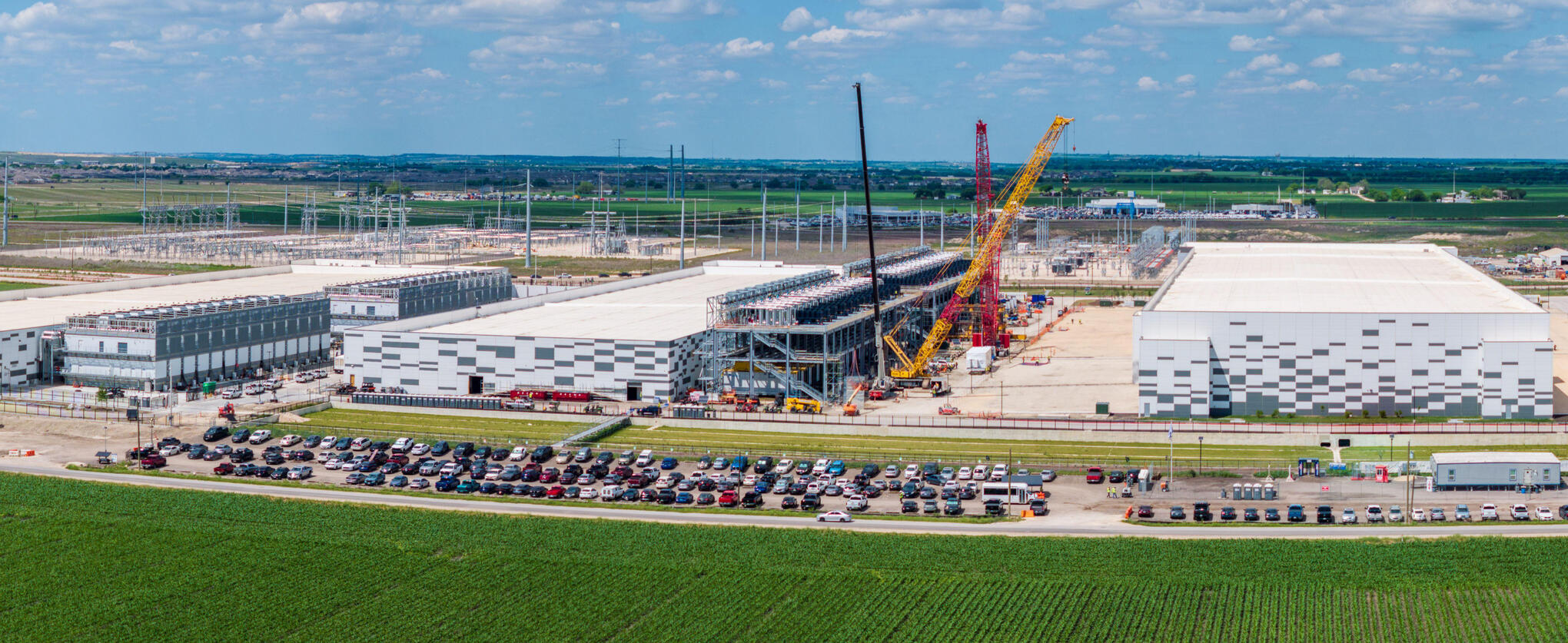
Skybox Datacenters — Hutto, TX
Tell Governor Abbott What Concerns You
Even though no data center has been formally proposed for the old Monticello site, many of the approvals a project like this need run through the State of Texas, not Titus County. That means Governor Abbott's office and state agencies have real influence over whether — and how — a project like this could move forward here.Why the Governor's office matters
Texas counties, including Titus County, do not have zoning authority. That means community push back depends on state-level tools — tax abatement programs, TCEQ water and environmental permits, and utility interconnection approvals.We do not want those tools to be used against rural communities like ours. State leaders need to build in more transparency and allow local input.What we're asking Governor Abbott to do
Require public notice and a realistic period for public comment before any state tax abatement or economic incentive is granted for a large data center project in Titus County.Direct TCEQ to require closed-loop cooling — not water-intensive evaporative cooling — for any data center seeking to operate in Titus County. Prohibit any data center developer from using our local water supply. Prohibit any discharge of contaminated, untreated water into either Lake Bob Sandlin or Monticello Lake.Require an independent water availability and impact study before any water permit is approved for a data center here.Support giving Texas counties more say over large industrial water users, since counties currently have no authority over these types of projects.How to reach Governor Abbott
Phone: 512-463-2000
Online form: gov.texas.gov/apps/contact-us/opinion
Mail: Office of the Governor Greg Abbott, P.O. Box 12428, Austin, TX 78711-2428Tip: Writing a letter takes more time, but it has a greater impact.Be sure to mention Titus County and the old Monticello Power Plant site. Ask him to support greater transparency and water protections for any future data center projects.Want to help? Sign up for updates and share this page with your neighbors.
Contact Us
Have a tip, a question, or something to share about the site? Send it our way below.
Thanks! We may follow up if more information is needed.